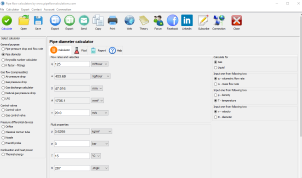
Description
- P - heat power
- Heat energy in the unit of time exchanged in the device.
- q - volume flow
- Volume flow rate of the fluid at actual pressure and temperature.
- ṁ - mass flow rate
- Fluid flow rate in terms of units of mass per unit of time
- T1 - inlet temperature
- Fluid temperature in front of the heat exchanger
- T2 - outlet temperature
- Fluid temperature after the heat exchanger
- ΔT - temperature change
- Fluid temperature difference before and after the heat exchanger. Gained or lost temperature depending if the device is a heater or a chiller
- ρ - fluid density
- Actual fluid density in terms of mass per unit of volume on real pressure and the temperature
- C - specific heat
- Heat capacity (specific heat) of the fluid; Specific heat at constant pressure for a gas, in terms of energy per unit of mass and temperature.
- D - diameter of tube
- Internal pipe diameter
- V - flow velocity
- Fluid flow velocity in the pipe of the heat exchanger
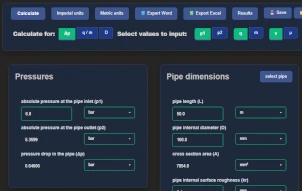
Calculation Setup
This guide explains how to configure the inputs for calculating heat power,
flow rate, temperature change, and pipe sizing for heating and cooling systems.
The calculator will automatically compute any value you do not select as an input.
- Select the type of calculation you want to perform.
- P
- Calculate heat power for a known flow rate.
- q / ṁ
- Calculate volumetric or mass flow rate for a known heat power.
-
Select which flow rate you want to enter.
Only the selected value should be entered; the other will be calculated automatically.
- q
- Volumetric flow rate.
- ṁ
- Mass flow rate.
-
Select the temperature value you want to input.
Enter the selected one; the other temperature parameter will be computed.
- T2
- Outlet temperature after the heater or chiller.
- ΔT
- Temperature difference across the heating or cooling device.
-
Select which pipe sizing parameter you want to input.
Enter the selected value; the other one will be calculated.
- D
- Internal pipe diameter.
- V
- Fluid velocity inside the pipe.
- Select the type of device used in the heat transfer process.
- Heater
-
Device where the outlet temperature is
lower than the inlet temperature
due to heat being transferred from the fluid to the surroundings.
- Chiller
-
Device where the outlet temperature is
higher than the inlet temperature
because the fluid absorbs heat and the surrounding medium is chilled.
What is a Heat Power Calculator?
The heat power calculator is a simple and effective tool for calculating the amount of heat energy transferred in a system.
It is particularly useful for:
- Hot water boilers
- Heat exchangers (air-to-water, water-to-water, etc.)
- Radiators and heating systems
- Water chillers and cooling systems
- Industrial heating applications
The calculator determines the heat power (Q) generated or required in a thermal system using specific heat as an input value.
How is Heat Power Calculated?
The heat power (Q) is calculated using the fundamental heat transfer equation:
Q = m × Cp × ΔT
Where:
- Q = Heat power (Watts or Joules per second)
- m = Mass flow rate of the fluid (kg/s)
- Cp = Specific heat capacity of the fluid (J/kg·K)
- ΔT = Temperature change (T₂ - T₁) in Kelvin (K) or Celsius (°C)
If volume flow rate (V) is used instead of mass flow rate (m), the equation becomes:
Q = V × ρ × Cp × ΔT
Where:
- V = Volume flow rate (m³/s)
- ρ = Fluid density (kg/m³)
What Inputs Are Required for Heat Power Calculation?
To use this calculator, you need to provide the following values:
- Specific heat capacity (Cp) of the fluid
- Mass flow rate or volume flow rate
- Initial temperature (T₁) and final temperature (T₂) of the fluid
- Density of the fluid (if volume flow rate is used instead of mass flow rate)
Once these values are entered, the calculator will instantly compute the heat power required or generated in the system.
Example Calculation
Suppose we need to calculate the heat power required to heat water in a heating system with the following data:
- Specific heat capacity: 4.18 kJ/kg·K (water)
- Mass flow rate: 2 kg/s
- Temperature increase: 50°C to 80°C
The heat power is calculated as:
Q = 2 × 4.18 × (80 - 50) = 250 W
This means that 250 watts of heat power are required to achieve the desired temperature rise.
Why Use a Heat Power Calculator?
The heat power calculator helps engineers, HVAC professionals, and energy analysts determine thermal power efficiently. It is beneficial for:
- Designing heat exchangers and radiators
- Optimizing hot water and steam systems
- Ensuring proper heating and cooling performance
- Evaluating industrial heating and process energy requirements
How to Use the Heat Power Calculator?
Follow these steps:
- Enter the specific heat capacity of the fluid.
- Provide the mass flow rate (or volume flow rate and density).
- Input the initial and final temperatures of the fluid.
- Click the calculate button to obtain the heat power.
The calculator will instantly display the required heat power output in watts or kilowatts.
Conclusion
- The heat power calculator is essential for determining thermal energy transfer in various heating and cooling applications.
- It requires inputs like specific heat, flow rate, and temperature difference to compute heat power.
- Common applications include boilers, heat exchangers, and HVAC systems.
Use this heat power calculator to ensure accurate and efficient energy calculations in your heating and cooling projects.